Time Value Of Money
If you have a choice of receiving a lump sum of money today or a periodic payment of the same amount over time which will you choose? You might think the latter would help you control your spending, but think again.
In inflationary terms, a dollar you receive today will always be worth more than a dollar you receive in the future. Time value of money(TVM in short) also tells us that any amount of money is worth more now than latter due to its potential interest earning prowess(If you invest it immediately). This applies to pension schemes, lottery winners or any scenario where you are given this choice. Always choose the lump sum payment.
The same concept can be used on day to day savings too. Buying in bulk is better than buying as and when necessary. Firstly, you will receive the bulk discount and secondly, you are saving money by not paying more at a latter time due to inflation. Which indirectly means, if inflation is 5% per year, you will save 5% from not buying the future goods if you have bought them in bulk at the present time.
2015 Custom Made Calendar Giveaway
To qualify, 1)Like my facebook page(here) 2)Share on your wall 3)Two of you(who liked and shared) will be chosen at random. You will be notified by end of the week through private message if you are selected. Good luck and thanks for reading!
POSB $148.77 Cash Gift Promotion
Time to transfer out some of your liquid cash from CIMB starsaver to your DBS/POSB account. You first have to register here. The amount go by multiples of $1000(max $20,000).
Once you register and demarcate the amount you want to deposit, transfer a single sum of between $1000-$20,000 to your POSB/DBS by 31st Dec 2014. The amount you transferred will be treated as a Fix Deposit which means you will not be able to use it for 6 months(something to take note of). The cash gift of 1.5% pa of the amount transferred will be credited to your designated account(max $148.77) by 30 June 2015.
The amount transferred have to be from other banks and not from DBS/POSB itself. Those transferring $10,000, you can use FAST transfer as it is capped at $10,000. Those who is transferring $20,000-$11,000 can use normal adhoc transfer(have to wait 2-3days). Quite a good deal in my opinion, more risk free value for your liquid cash.
Is Saving And Investing Bad For The Economy?
When you invest in bonds. You are actually assisting companies to grow by helping them raise cash. The market capitalization of a company is dependent on its share price. So when you buy stocks to invest, you too are supporting the value of the company. I don't see how these "smarter" options are 'bad' for the economy. To the contrary I think they are very much helpful.
When you put your money into your savings account, you are basically loaning money to the bank. They give you an interest payment every month and use your money to invest or loan out for a higher yield. Both parties are beneficial. Instead of helping the retail sector, you are assisting the banking sector. Which is good for the economy.
Unless of course, if you keep physically cash in a biscuit tin hidden under your bed, then that would be bad.
Can Simplicity Lead You To Authenticity?
He talked about rediscovering ourselves by doing the direct opposite, which is: simplifying. Instead of searching for new things to adapt, learn and become, we should find things to remove and simplify. Instead of working hard to increase our income, we should think of reducing our expenses. He said one can only find him/herself by removing things and that removal is the foundation of simplicity. Quite an interesting concept but strikingly different from my worldview.
I am veered more towards John Locke's tabula rasa(clean slate) view which argues that all of us are born with a mind identical to a blank slate, on which experiences are written. Hence we do not have innate ideas, but rather ideas that are fed into us by experiences. I find it difficult to understand Kent's meaning of 'self'. I see the self as an ever changing persona that becomes more and more complex over time. More of a self authorship of ourselves than his version of an innate pristine self that can be found through simplicity. Interesting nonetheless.
3 Questions Educated Consumers Ask Themselves
1) Is this a necessity or a want? If not buying will negatively affect your lifestyle, then its a necessity. If it is, think it through and tell yourself whether you have done a thorough price comparison with similar items. If it is a want, ask yourself whether you can delay it.
2) Is it worth foregoing a chunk of your investment money to buy this? Big ticket items will usually dig into your bank reserve/investments which are actively collecting interest. Do you love this item so much that you are willing to forego precious interest for it?
3) Is there a substitute for this item that you can think of? Most retail items are easily substituted with cheaper alternatives. Do not get blinded by flashy advertorial exteriors. Reduce it to its simplest form/function and see if it is still worth your money.
Hope these questions can be of help to you when you make your next purchase.
3 Financial Codes To Abide By
We all have our own financial codes to live by. Mine is more simple and pragmatic. I believe as long as we try to stick to it diligently, less/no financial turmoil will come our way. Here are three financial codes that I live by:
1) Do not over leverage your money. Spend less than you earn and save the rest. Attaining financial freedom is a long term process. Abusing your credit card to fulfill short term wants is a recipe for disaster. You can look and plan further than that.
2) Know what you want and do not be influence by your peers. After I knew I was going to be a father, I opted for a term insurance plan because my aim is to protect my child and wife incase anything bad were to happen to me within this 25 years. Thats all I need, and thats all I will get. I believe investment and insurance should be separated.
3) Do not be affected by how other people see you. You are competing with yourself and no one else. Never fall into the trap of "trying to live up to the expectations of others", because you will be living and earning for the sake of others. Instead, do what you like in a cost efficient way and enjoy your life.
Savings And Investing
It is prevalent among first time investors to be afraid of financial loss. If you were to start from savings and move gradually to investing, the fear will subside. You will have a bigger cushion of safety by then. You will also treat every investment as if it was your last. Since it is hard to compound dividend received from stocks(due to min of 1lot per share), a good saver knows how to find the best savings account for dividend compounding.
Putting your money in a special savings account like OCBC360(assuming all 3 conditions are fulfilled and 50k deposited) gives you $127 a month, that itself is a form of risk free investing. By maximizing your savings, you are indirectly trying to 'master' your savings. So by all mean, master your savings first before moving on to investing. That would be a more prudent way to grow your money safely.
Dividend Stock Investing
Track record is also important. Look back over the years and check the company's dividend payout. Make sure it is fairly consistent through the good and bad times. A good track record gives you a better impression of the company that you will be invested in. That is why IPO stocks are such a hassle to valuate, as you may not get a concrete picture of their past perfomance.
Lastly, take note of company's debt. Make sure its net debt is small. It would be even better if its net debt is nil. As net debt would indirectly affect your dividend payout. A lower debt to equity ratio would also imply a more financially stable stock, which makes for a good candidate for passive investing.
For me, it is always preferable to choose stability and sustainability over high yields. So do look out for these basic pointers when you do cash flow investing.
3 Habits That Promote Bad Debt
Bad debts to me are debts incurred to buy into depreciating assets. For example, consumables, car, clothes etc. These are the kinds of debt we have to avoid. There are three habits that attracts bad debt. We should take note of them so that we can break them.
1) Spending without forethought(aka impulsive spending). The ease of cashless transactions, like pay wave now have contributed to this habit. A person who buys because of emotional reasons(hype etc) without thinking pragmatically is prone to have bad debts
2) Spending to impress. Trying to show off to your neighbours or relatives that you are on par or better than them financially and hence forcing yourself to take a loan to buy into items that you cannot handle. Items can range from holiday trips, car, furniture to even a house.
3) Spending optimistically. Thinking that you can earn back the money quickly to pay off all your debts anyway. You have to be a pessimist in regards to pay increment and assume that it isn't guaranteed. Having an optimistic spending habit does not help you in anyway. Best to be aware of the possible bad scenarios that might happen, this will prevent you from getting into debts you cannot handle.
Try to think every purchase through. Do everything in moderation and always within your means. Hope this post can be of help to you.
Holiday Must Haves
DBS too just announced a new feature on their website. Basically, its a lucky draw system using your handphone. If you spend $200 in a single receipt with a DBS/POSB card, just SMS: XMAS DBS/POSB card no. followed by your spent amount. to 76060. You will most likely win a cash rebate and if you are lucky, some vouchers or even an iPhone 6. A $5 rebate is equivalent to a 2.5% discount. Each cardmember is entitled to one gift a day. The possbilities are endless, but solely dependent on your luck. If you have fulfilled your $500 OCBC Frank card spending, you can consider using Amex True Cashback Card or DBS credit cards as a complimentary.
Indicative Bond Prices For Today
Please read the disclaimer at the bottom of my blog if you wish to continue with the contents below.
![]() |
| From CIMB dated 10/11/14 |
To calculate current bond yield, just use (Annual interest payment) / (Clean price). For example if CK bond coupon is 5.125%. Annual interest is 5.125% x 100 = 5.125. Therefore current bond yield is 5.125 / 97.10(buy price) = 5.28%.
Perpetual bonds are still getting hit by the potential interest rate hike next year. Except for some strong names like Mapletree Log Trust, UOB, DBS and the recent new issue Ascott Residence Trust as shown above. Alot has got to do with the issue size, ratings and step up mechanisms, so we have to judge accordingly.
Bought iPhone 6+ Today
![]() |
| From Singtel Website |
My wife has been using her old iPhone 4 for three years now. It finally broke down today, so we made a trip down to our local telco to purchase a new one. Just in time for the new iPhone 6+?
The price comparison from the three telcos are pretty much similar, but we chose Singtel mainly for its 10% monthly bill discount due to the bundling with our fiber optics. I remembered reading an article on an independent 4G speed test for the three telcos sometime back and Singtel came out on top(article here).
Basing primarily on Sintel price plan alone, we can compare the combo plans and calculate the total price payable for a two year contract(monthly subscription cost x 24 + phone price). Combo 2 seems the most suitable out of the six.
I personally think free smses and local call mins are unimportant now, as Whatsapp and Viber can take their places. My wife mainly just surfs websites on her phone, so a 2GB mobile data is more than enough. Here is a picture of her phone:
Compound Semi Annually or Quarterly?
Asumming you have an option to buy into two stocks that are exactly the same. The only difference is that one gives a 6% annual yield twice a year and the other gives a 6% annual yield four times a year. You might think that both are pretty much equal in value, but think again. In the spirit of compounding, the shorter the compounding interval, the more money you will receive in the end.
Assuming a base amount of $100,000 and a calculation period of 10 years. This is the amount you will get if you compound twice a year:
This is the amount you will get if you compound four times a year:
As you can see, after ten years, the quarterly compounded stock gives you $790.72 more interest. Although the difference is slight, it is something to take note of. Always choose the stock that gives you dividend on a shorter interval basis assuming everything remains equal.
3 Ways to Reduce Your Monthly Expenses
There are a million and one ways to spend money in Singapore, but it is much harder to find ways to reduce expenses. More so for monthly incurred expenses that eats up your earnings constantly. You might assume that your monthly expenses are for your basic necessities and are fixed, but that may be not true. Here are three ways to reduce your monthly expenses:
1) Streamline your monthly bills. Do you really need that gym membership? Can you do away with it or is there a cheaper alternative? Do you really need 1000 Mbps of fibre speed? Do you really need 800 mins of voice/video calls, 5000 free sms/mms when 4G plans all share the same download speed? The monthly cost of the best plans are usually 2-3x that of an average plan. It really depends on you, try to think it through and do not get yourself into a plan that doesnt suit your pocket.
2) Reduce food expenses. It is a no brainer when you see aggressive discounts for your groceries in NTUC on one hand and the high service charges and cost from dine ins on the other. Both are telling you to prepare your own meals at home. Consider taking your lunch to work and have your dinner at home. At least try your best to. This can drastically reduce your monthly food expenses.
3) Reduce your utility bill. It makes up a big bulk of your monthly expenses so all the more reason to manage it well. Switch off the lights, air condition and heater when they are not in used. It is also worth while to invest in energy efficient light bulbs as they will bring your total electrical consumption down quite significantly.
Hope all these tips can be of help to you.
Peter Lynch's PEG ratio
PEG(price/earnings to growth) is a modification of PE(price/earnings) made popular by Peter Lynch. It is basically a ratio, just like the popular PE, but with growth taken into account. PEG ratio is (PE ratio) divided by (annual EPS growth). For stocks in similar sectors, you can use PEG ratio to find value. It adds another component to your analysis and makes it more complete. Below is an example:
OCBC, DBS and UOB as of today have rolling PE ratios of 10.8x, 11.213x and 11.475x respectively. If you were to judge by PE alone, OCBC looks the most attractive and UOB looks the least with DBS in between. The results may look very different if you add earnings growth into the equation.
PEG ratio(PE/EPS CAGR 5years) of OCBC, DBS and UOB are 1.46x, nil(cannot be computed when EPS growth is neg) and 1.42x respectively. With growth taken into account, UOB becomes the most attractive, followed by OCBC then DBS.
PEG explicitly inserts a value on the growth in earnings of a company. It tells you whether high PE translate to overpricing or fast growth. I think it makes for a useful component in day to day analysis.
My Thoughts on Starhill Global 3Q14 Result
Please read the disclaimer at the bottom of my blog if you wish to continue with the contents below.
![]() |
| Collated using Shareinvestor |
Better late than never. I have collated the latest 3rd Qtr result together with its four previous quarters back to back in the table above. I have also stripped away the change in fair value for its 4th Qtr 2013 for better comparison. Quite a nice progression of numbers. We see a gradual reduction in operating expenses and a gradual increase in gross profit and DPU. The rest remained fairly consistent.
Property expenses are lower for the current quarter mainly due lower operating expenses incurred by the Singapore Properties, Japan Properties and Renhe Spring Zongbei Properties. Finance expenses are higher for the current quarter mainly due to interest costs accrued for the S$100mil unsecured MTN which was issued in February 2014.
The group has no refinancing requirement until July 2015, where the maturing S$124mil MTN is covered by the avaliable undrawn committed credit facilities and/or untapped balance from their MTN programme. 100% of its debt have been fixed/hedged.
Its Singapore portfolio(contributing 67.1% of their total revenue) gained 3.8% NPI yoy to S$26mil. As of Sep 2014, its weighted debt to maturity is at 3.6 years with a gearing of 29.1%. Price to book is at 0.87x and 16.53x rolling PE(if change in fair value is removed). Despite the drag down by its China portfolio, its overall 3Q result looks quite remarkable. Will be looking forward to its full year result(end Jan 2015).
Be a Frugal Utilitarian
It is quite the rage now to live a lifestyle of thrift. Many assume that if you cut back on expenses, you will naturally have more savings. I do not agree. Choosing the cheapest alternative all the time may not bold well for you in the long run and may end up costing you more.
You might think that it is smart to hold back on servicing your air condition. But when it turns faulty later on, a chemical wash will cost you much more. Buying cheap hawker center food and fast food takeaways may look like smart money management, but many fail to realize that these kinds of food are usually bad for health. Health issues like obesity, heart disease etc may cost you more money to treat down the road. Insurance is also another important aspect. It is not wise to avoid/reduce your monthly premiums just to save a few hundred dollars. In the long run, too little insurance may cost you a fortune(under covered).
I think we should strive to be a Frugal Utilitarian. Always look at the overall picture and not solely at the immediate dollar and cent. If we focus more on the quality to cost ratio and not just solely on the cost itself, we can end up saving more in the long run.
Best Savings Accounts for 2014
My criteria for best savings account is primary based on two factors: interest rate, and how easy it is to meet the requirements. In a cash rich situation, putting money into your savings account gives you an added advantage as compared to being locked up in a fixed deposit. Your cash gets the monthly interest and you can still move the money out anytime when opportunity strikes. These three choices of mine, can be used together if you wish to be temporarily out from the equity/bond market.
2) CIMB Starsaver savings account gives 0.8% per annum with very easy to meet requirements. Basically you just need to deposit at least $1000 from the start and make sure the principal amount increases by $100 every month. If you put in $50,000 for example, it will automatically separate the total amount to packets of $100 increment each month, which gives you 0.8% interest for the whole $50,000 for many months to come. As it is capped at $750,000, it enables compounding. Which makes it a good candidate for putting interest earned from OCBC360 and DBS multiplier into it if both are capped. The easy to meet requirement, high capped amount and reasonable interest at 0.8% makes this my second best choice.
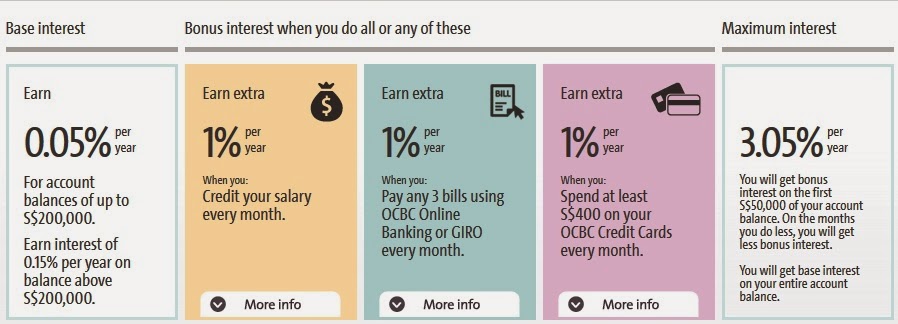
1) The best savings account for 2014 definitely goes to OCBC 360 for its highest interest earned(3.05%) and easy to meet requirements. Its interest is better then most SGS and short term rated corporate bonds out there. The requirements of paying three bills, crediting your salary and spending $400 on credit card are pretty easy requirements to meet. It is capped at $50,000 so this should be the first account one should max out(if you can meet at least two of the three requirements).